




Complete Guide to CT Passive Temperature Monitoring Kits: Wireless Switchgear Safety
Loose connections destroy electrical switchgear. When mechanical vibration, oxidation, or thermal cycling loosen busbar joints and breaker stabs, contact resistance spikes. This generates intense localized heat that can trigger arc flashes and shut down an entire plant.
Traditional inspection methods come with severe compromises. Infrared thermal guns only catch problems during scheduled walk-throughs, missing sudden load spikes. Hardwired sensors introduce dangerous conductive paths across high-voltage insulation gaps. Battery-powered wireless pucks remove the wires, but maintenance crews must de-energize cabinets every three years just to replace dead cells.
The HAOSHENG CT Passive Temperature Monitoring Kit solves these problems directly. By drawing power straight from the conductor's magnetic field, this continuous thermal monitoring system operates without batteries or external sensor wiring.
How Current Transformer Energy Harvesting Works
Instead of relying on lithium thionyl chloride cells that degrade under high cabinet heat, the HS-CT-WF passive sensor uses current transformer (CT) induction. It pulls operating power directly from the magnetic field around the monitored AC line.
High-permeability magnetic cores wake the sensor at just 5 Amperes of primary current. Solid-state micro-capacitors store the rectified charge. Once powered, the sensor measures surface temperature, digitizes the reading down to 0.1°C, and broadcasts an encrypted burst over the 433 MHz industrial band in milliseconds.
This passive approach strips out routine overhead:
- Zero Battery Swaps: No more scheduled outages to dig out and replace depleted cells in tight switchgear compartments.
- 10-Year Design Life: Solid-state components match the typical service intervals of primary switchgear assets.
- Dielectric Isolation: Complete physical separation protects low-voltage control circuits from high-potential flashover.
- Thermal Stability: Eliminates volatile battery chemistries that leak or swell under sustained busbar heat.
Hardware Architecture: Sensors and Acquisition Hubs
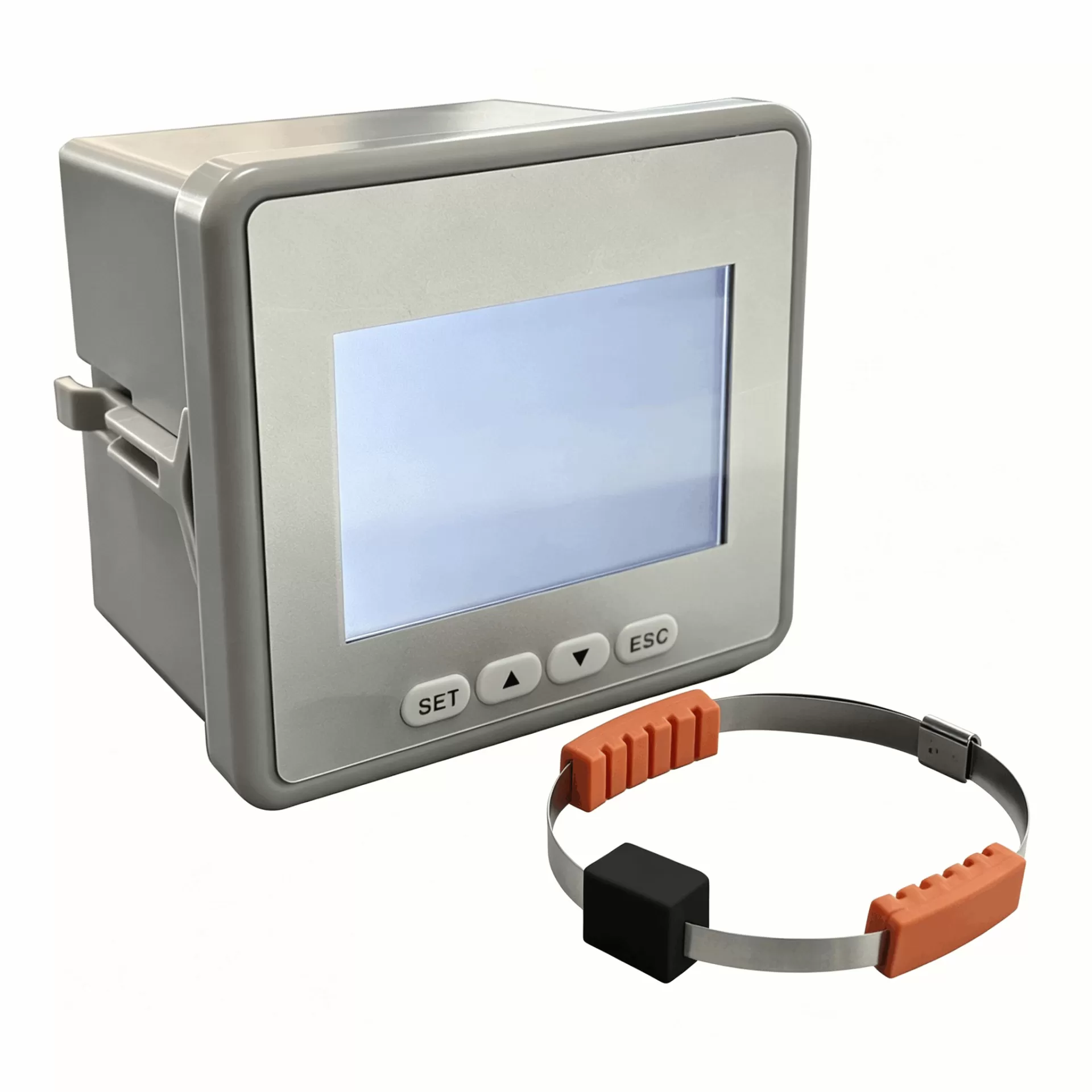
The HAOSHENG CT Passive Temperature Monitoring Kit operates as an integrated ecosystem, pairing low-profile sensors with a multi-channel receiving host.
1. HS-CT-WF Passive Temperature Sensor
The HS-CT-WF mounts directly on busbars, breaker finger clusters, disconnect switches, and cable terminations. Measuring just 26 mm × 22 mm × 10 mm, this IP65-rated sensor resists moisture, industrial dust, and corrosive fumes.
Technicians secure the unit using non-magnetic stainless steel strapping. This requires no drilling or conductor alteration, keeping surface contact tight for accurate thermal transfer.
- Measurement Range: -40°C to +125°C.
- Accuracy: ±0.5°C at ambient; ≤±1.0°C across the full operating range.
- Thermal Endurance: Handles emergency loads up to 155°C for 2 hours, and short-circuit surges up to 250°C for ≤4 seconds.
- Wireless Range: ≥300 meters line-of-sight in open conditions.
2. HS-CT-HF Data Acquisition Host
The HS-CT-HF host manages data aggregation. It mounts flush into the low-voltage door cutout (92.5 mm × 72.95 mm) and coordinates wireless telemetry across nearby sensors.
A single host tracks up to 240 passive CT sensors at once. This capacity lets one unit supervise multiple switchgear cubicles, including incoming lines, bus ties, and feeder terminations.
The front panel features a 3.2-inch color screen (320 × 240 resolution) and four navigation keys. Operators can check real-time phase temperatures, evaluate trends, and view alarm histories without connecting a laptop. If temperatures cross safe limits, the screen flashes red and an internal buzzer sounds immediately.
Technical Specifications
The tables below summarize the operational specifications for both primary kit components.
Passive CT Sensor (Model: HS-CT-WF)
| Parameter | Specification | Parameter | Specification |
|---|---|---|---|
| Temperature Range | -40°C to +125°C | Accuracy | ±0.5°C (Ambient); ≤±1.0°C (Full Span) |
| Resolution | 0.1°C | Frequency | 433 MHz Industrial Band |
| Power Supply | CT Induction Harvesting | Startup Current | ≥5 Amperes |
| Wireless Range | ≥300 m (Open Air) | Service Life | 10 Years |
| Ambient Rating | -40°C to +85°C | Heat Tolerance | 155°C for 2h; 250°C for ≤4s |
| Mounting Method | Stainless Steel Strap | Ingress Rating | IP65 |
| Dimensions | 26 × 22 × 10 mm | Maintenance | None (Battery-Free) |
Acquisition Host (Model: HS-CT-HF Series)
| Item | Specification |
|---|---|
| Sensor Capacity | Up to 240 CT passive sensors |
| Local Display | 3.2-inch Color TFT LCD (320×240) |
| User Interface | 4 navigation buttons with password-protected menus |
| Alarm Modes | Flashing red visual display + audible buzzer |
| Standard Interfaces | Dual RS485 (Modbus-RTU) + Wi-Fi (Modbus-TCP / MQTT) |
| Cellular Uplink | Optional 4G LTE Full-Netcom module |
| Input Power | AC 220V standard (DC 12V or DC 24V optional) |
| Power Draw | ≤10 Watts |
| Operating Range | -20°C to +70°C; ≤90% RH (non-condensing) |
| Cutout Size | 92.5 mm × 72.95 mm (Panel mount) |
Kit Versions and Field Applications
Every facility runs on different network architectures. To simplify procurement, HAOSHENG packages the hardware into two distinct configurations.
| Kit Edition | Sensor | Host | Communications | Target Installations |
|---|---|---|---|---|
| Standard Kit | HS-CT-WF | HS-CT-HF | Dual RS485 + Wi-Fi; Modbus-RTU, Modbus-TCP, MQTT | Main plant substations, MCC lineups, indoor switchgear rooms. |
| 4G Custom Kit | HS-CT-WF | HS-CT-HF-4G | RS485 + Wi-Fi + 4G LTE cellular data upload | Pad-mounted transformers, remote wind/solar sites, BESS containers. |
Where These Kits Fit Best
Industrial Plants: Continuous processing facilities like chemical plants, paper mills, and foundries cannot tolerate sudden trips. The standard kit plugs straight into plant SCADA systems via RS485 or Wi-Fi, tracking busbar thermal profiles under heavy motor starts.
Pad-Mounted Box Transformers: Compact outdoor transformers trap heat and choke off airflow. Space is tight on primary bushings. The HS-CT-WF fits into these compact zones easily, while the 4G host routes thermal readings straight to off-site maintenance teams without long data cables.
Renewable Generation and BESS: Inverter feeds, solar collector panels, and battery energy storage enclosures run continuous high currents that cycle repeatedly. The CT Passive Temperature Monitoring Kit handles these heavy cycling loads without thermal drift, tracking feeder health in real time.
Installation and Integration Workflow
Installing the kit does not require destructive line modifications. Teams can retrofit an entire switchgear section during a standard planned outage.
- Attach the Sensors: Clean the conductor contact area. Place the concave thermal shoe of the HS-CT-WF flat against the busbar or lug crimp. Wrap the stainless steel strap through the sensor body, tighten with a tensioner, and lock it down.
- Mount the Host: Cut a 92.5 mm × 72.95 mm opening in the low-voltage auxiliary door. Slide the HS-CT-HF host into place, tighten the side brackets, and wire the auxiliary power supply.
- Run the Antenna: Feed the 433 MHz whip antenna from the back of the host into the busbar or cable compartment. Position the antenna tip with a direct line of sight to the sensor cluster to prevent metal shielding.
- Set Up Software: Connect a laptop to the host via RS485 or local Wi-Fi. Map each sensor's unique ID to its actual phase location (for example, "Feeder 2 - Phase B Breaker Stab"). Program your thermal alert and trip limits.
Frequently Asked Questions
What happens if conductor current drops below 5 Amperes?
Below 5A, the magnetic field cannot generate enough power to run the sensor's radio, so transmissions stop. Because ohmic heating ($I^2R$) requires current, conductors running under 5A cannot overheat from contact resistance. The moment line load reaches 5A or more, the sensor restarts in milliseconds and resumes reporting before any heat buildup can develop.
Can the sensor survive heavy short circuits?
Yes. The induction core uses magnetic saturation protection to prevent transient fault currents from over-volting internal circuits. Mechanically, the housing handles short-term thermal spikes up to 250°C for ≤4 seconds, outlasting standard breaker fault-clearing intervals.
How do signals escape grounded metal switchgear?
Switchgear enclosures block 2.4 GHz signals like Bluetooth and standard Wi-Fi. The HAOSHENG system uses 433 MHz sub-GHz waves instead, which move around metal obstacles much better. Additionally, installers route the host's antenna directly inside the high-voltage bay, keeping the whole RF path inside the compartment.
How does the host connect to our plant SCADA or PLC?
The HS-CT-HF acts as a field gateway. It maps data directly to Modbus-RTU registers over dual RS485 ports, or serves Modbus-TCP and MQTT JSON streams over Wi-Fi and 4G. You can read registers directly into standard automation platforms without buying proprietary drivers.
Are custom versions available for OEM projects?
Yes. HAOSHENG provides custom OEM and ODM builds. Options include expanded node licenses, custom enclosure colors, private labeling, DC-only power supplies, and region-specific cellular modems.
Built for Resilient Power Distribution
Predicting switchgear failures requires dependable, continuous data. The HAOSHENG CT Passive Temperature Monitoring Kit replaces periodic manual inspections and risky battery-powered sensors with a dependable, line-powered design. Facilities get clear visibility into high-voltage thermal stress, keeping equipment running and crews safe.