




How to Choose the Right Water Immersion Sensor for Mission-Critical IoT Environments?
A mission-critical facility cannot tolerate blind spots. In server halls, cleanrooms, and energy substations, unexpected fluid leaks threaten physical infrastructure directly. Installing a reliable water immersion sensor forms the first line of defense against electrical shorts, corrosion, and unplanned outages. Industrial operations require continuous oversight to prevent minor drips from escalating into catastrophic failures.
HAOSHENG engineers robust sensing technologies designed to safeguard sensitive infrastructure against liquid damage. If your enterprise is upgrading its environmental safety systems, talk to our engineering team today to evaluate specialized hardware configurations or request evaluation samples for live testing.
Contact HAOSHENG to Request an Industrial Sensor Consultation
The Strategic Imperative of Fluid Detection in Critical Facilities
Liquid leaks in an enterprise facility are not simple housekeeping issues. Chilled water loops, condensation pans, and external ingress can flood subfloors silently. Without automated detection, operators discover leaks only after hardware drops offline.
Consumer-Grade vs. Industrial Water Immersion Sensor Performance
Off-the-shelf consumer sensors fail quickly in demanding environments. Consumer devices rely on cheap plastic enclosures, basic DC excitation circuits, and fragile copper traces that corrode within months. In contrast, an industrial water immersion sensor provides galvanic isolation, high mean time between failures (MTBF), and rapid signal response under heavy thermal variations.
- Response Latency: Industrial units trigger alerts within milliseconds, whereas consumer devices often poll at slow, battery-saving intervals.
- False Positive Filtering: Industrial units filter out ambient humidity spikes; consumer alarms trigger on condensation alone.
- Component Longevity: Hardened probes resist electrolytic degradation, operating reliably across continuous multi-year deployments.
The Hidden Overhead of Undetected Liquid Ingress
Downtime carries a massive price tag. For an enterprise facility, an uncontained leak means breached service level agreements (SLAs), emergency hardware replacements, and potential structural rot. Water creates conductive paths across power buses, destroying high-density compute nodes instantly.
Secondary damage costs frequently exceed initial repair bills. Corrosive fluid vapors attack sensitive silicon, void warranties, and spike cyber-physical insurance premiums. Deploying an enterprise-grade water immersion sensor for data centers mitigates these liabilities before fluids compromise running workloads.
Integration with DCIM and BMS Frameworks
Modern Data Center Infrastructure Management (DCIM) and Building Management Systems (BMS) require rich telemetry, not isolated buzzers. Fluid alarms must integrate directly into upstream control planes via standardized protocols.
When an immersion detector registers liquid, the central BMS can trip solenoid shut-off valves automatically. Simultaneously, the DCIM shifts compute loads away from the affected server rack zone, preserving uptime seamlessly.
Sensor Topologies: Rope-type vs. Point-level Water Immersion Sensor
Selecting the mechanical topology depends entirely on site layout, airflow, and equipment geometry. Infrastructure architects typically balance focused containment against broad perimeter coverage.
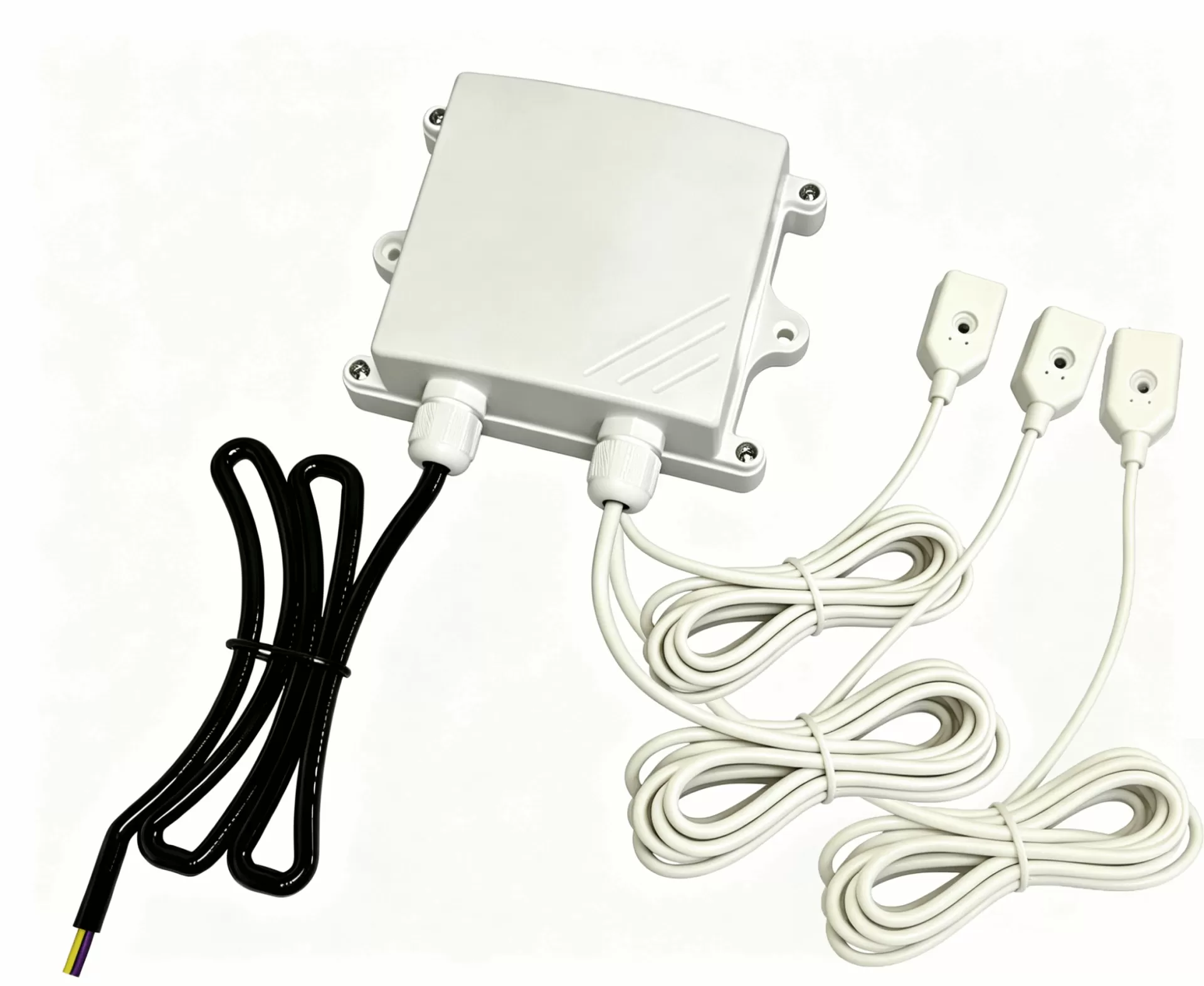
Point-Level Water Immersion Sensor
Point detectors monitor specific, high-risk targets. They rely on exposed conductive pins positioned millimeters above a surface or resting directly on the floor plate.
- Operating Principle: The sensor applies an alternating current (AC) across two conductive electrodes. Liquid bridging the gap completes the circuit, altering conductivity and firing an interrupt signal.
- Best Applications: Sump pump basins, condensed water drain pans, and the baseplates beneath computer room air handlers (CRAH).
- Engineering Limitations: Point units create spatial blind spots. If water flows around a localized probe, the system remains silent until water levels pool broadly.
Rope-Type Water Immersion Sensor
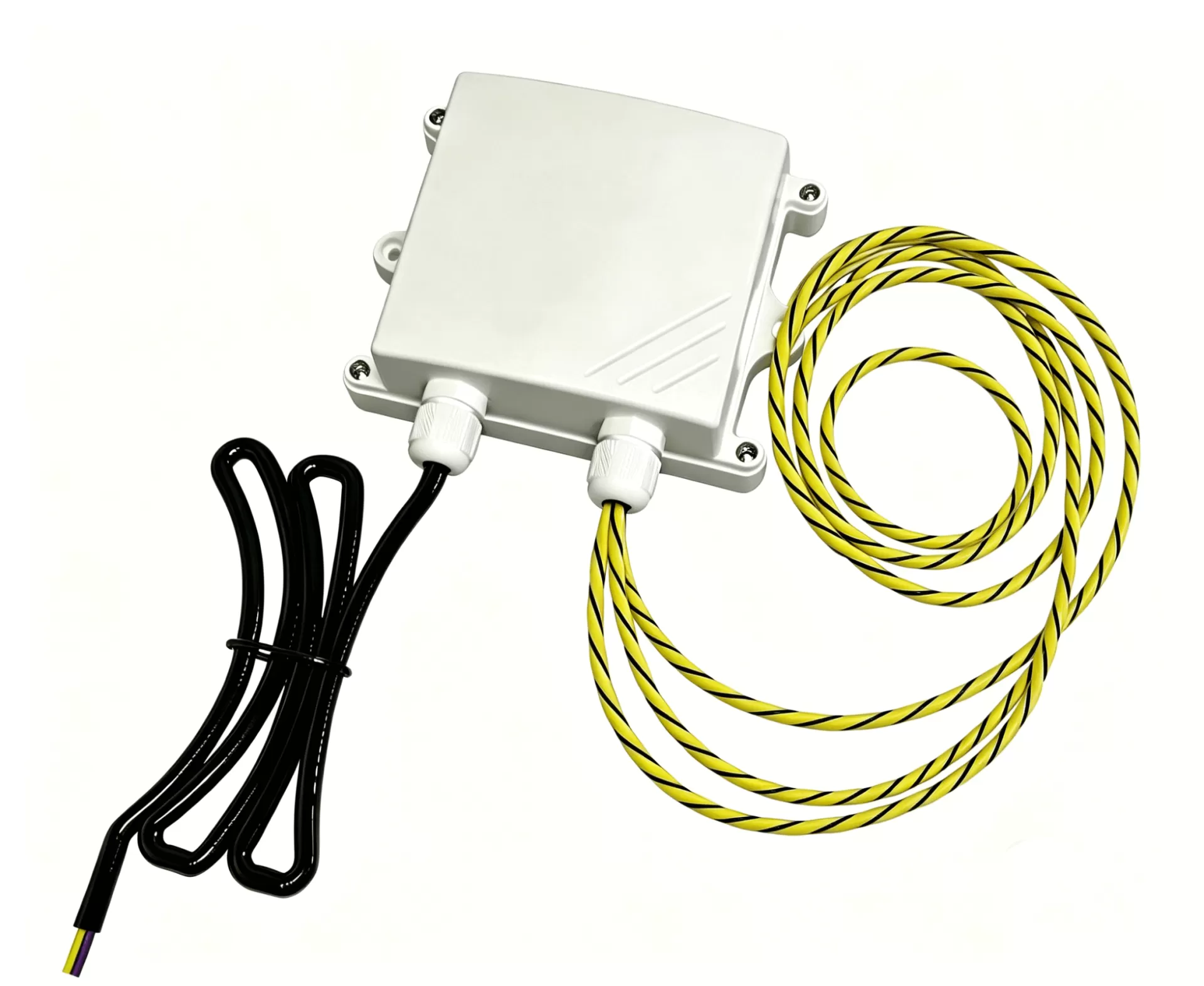
Rope or cable sensors resolve spatial limitations by transforming the detection circuit into a continuous line. This design is critical when evaluating rope-type vs. point-level water immersion sensor options for large facilities.
- Operating Principle: Two conductive polymer wires run spiraled within a non-conductive carrier braid. Fluid touching any portion along the cable completes the circuit between the conductive cores.
- Zonal vs. Location-Based: Zone cables confirm water presence somewhere along the loop. Location-based systems measure resistance variations to pinpoint the leak position down to the exact meter.
- Primary Applications: Surrounding raised-floor perimeters, running alongside chilled liquid manifolds, and snaking beneath high-density server rows.
Optical Non-Contact Water Immersion Sensor
Certain aggressive industrial contexts rule out standard conductive pins. Optical systems provide a specialized alternative for high-risk points.
These units project infrared light through a prism. Under dry conditions, internal reflection bounces the beam entirely back to a phototransistor. Fluid covering the outer dome refracts the light outward, reducing return intensity and triggering the alarm. Optical units excel in chemical processing rooms and strong electromagnetic interference (EMI) fields.
Hardware Engineering and Environmental Resilience
A water alarm must outlast the environment it protects. Inferior alloys corrode over time, while fragile plastics warp under thermal stress.
Probe Metallurgy and Corrosion Resistance
Standard metals suffer from electrolytic erosion when exposed to moisture and current. Direct current (DC) detection circuits destroy electrodes through electrolysis in weeks.
High-grade sensors employ high-frequency AC excitation to cancel out ion migration. Furthermore, physical contact points require specialized metallurgy:
- Gold-Plated Brass: Offers low contact resistance; ideal for dry indoor server environments with low chemical exposure.
- 316L Stainless Steel: Outstanding resistance to oxidation, acidic condensation, and industrial washdown agents; the premier choice for demanding plant floors.
IP Ratings for Water Immersion Sensors and Enclosures
Field installations demand asymmetric ingress protection between the sensing interface and the processing logic. The detector probe sits in fluid, requiring an IP68 rating for sustained submersion under hydrostatic pressure.
Conversely, transmitters and wireless transceivers mount to walls or cabinet struts. An enclosure rating of IP65 or IP66 provides sufficient protection against airborne humidity, splashing wash-water, and particulate buildup without adding unnecessary bulk.
Adaptive Anti-False-Alarm Mechanisms
False alarms frustrate operators and trigger costly operational shutdowns. Facilities running cold-aisle containment systems naturally generate ambient condensation and minor humidity swings.
HAOSHENG integrates onboard threshold-tuning algorithms that distinguish between slow humidity condensation, dust layers, and sudden pool immersion. Digital filtering discards brief conductive spikes caused by static discharges or cleaning equipment, ensuring alerts reflect true structural emergencies.
Connectivity and Integration: Wireless vs. Wired Protocols
Data transmission choices dictate installation speed, network maintenance overhead, and latency profiles during a leak event.
Wireless LoRaWAN Water Immersion Sensor vs. NB-IoT
Battery-powered wireless sensors allow fast retrofitting across established facilities where pulling field wiring is cost-prohibitive. Choosing between LoRaWAN and NB-IoT comes down to infrastructure ownership.
- LoRaWAN Advantages: Sub-GHz frequencies penetrate raised steel floor tiles, concrete floors, and metal racks. Facility operators maintain private gateways with zero recurring SIM charges. A modern wireless LoRaWAN water immersion sensor operates for 5 to 10 years on an internal LiSOCl2 battery.
- NB-IoT Trade-Offs: Cellular links connect directly to commercial base stations without local gateways. However, subterranean basements often suffer carrier dead zones, and recurring cellular data contracts increase long-term operational costs.
Wired RS485 Modbus RTU and Dry Contact Integration
Wired connectivity remains the benchmark for zero-latency industrial automation. Safety interlocks that control physical water valves often prohibit wireless links entirely.
A wired water immersion sensor provides standard RS485 Modbus RTU loops, broadcasting liquid depth, diagnostic flags, and circuit health directly to PLCs. Alternatively, form-C dry contact relays offer fail-safe hardware cuts. If the sensor loses line power or detects fluid, the relay opens instantly, killing power to fluid pumps without software dependencies.
Network Security and Signal Integrity
Industrial IoT sensors can introduce vulnerabilities if neglected. Attackers targeting building control planes use unsecured sensor nodes as lateral stepping stones.
Wireless links must mandate AES-128 cryptographic key exchanges directly from device to network server. Wired networks need shielded twisted pairs (STP) to prevent motor variable frequency drives (VFDs) from injecting inductive noise into sensitive liquid readings.
Fail-Safe Diagnostics and Lifecycle Management
A silent sensor is dangerous if operators assume it works when it has actually broken down. Robust safety infrastructure requires constant self-verification.
Cable-Break Diagnostics
Point-to-point conductive cable loops are vulnerable to snagging during server maintenance. If a technician accidentally cuts a detection rope, standard systems might interpret the cut as an open, dry circuit.
Industrial rope systems use terminal end-of-line (EOL) resistors. Transceivers run an end-to-end continuity heartbeat. If someone cuts or unplugs a sensing rope, the system registers an immediate impedance drop, triggering an equipment fault alarm rather than leaving the zone unprotected.
Post-Incident Dry-Out Time and Cable Reusability
Cheap sensor ropes absorb dirty water like wicks, requiring manual replacement after an incident. This slow recovery delays facility reactivation.
Engineered conductive polymer cables do not absorb fluid internally. Once technicians vacuum water away, the rope surfaces dry out within minutes. The sensor clears its alarm state rapidly, permitting instant system restarts without purchasing new sensing ropes.
Real-Time Battery Telemetry
Deploying hundreds of wireless sensors across a massive site introduces battery replacement headaches. Simple voltage readings are unreliable because lithium thionyl chloride cells maintain flat voltage curves until they drop suddenly.
Advanced wireless units incorporate battery discharge algorithms that track run-time, transmit counts, and environmental temperatures. This data routes directly to maintenance dashboards, allowing teams to swap power cells during planned service windows.
Mission-Critical Facility Deployment Matrix
Every facility demands a specific mix of physical design, networking protocol, and sensor housing. Use this matrix to match sensor configurations to operational needs:
| Facility Profile | Optimal Sensor Architecture | Primary Connectivity | Ingress Protection | Relative Capex |
|---|---|---|---|---|
| Hyperscale Data Center | Location-based Rope Sensor | RS485 Modbus / LoRaWAN | Probe IP68 / Base IP65 | Moderate to High |
| Semiconductor Cleanroom | Non-Contact Optical & 316L Rope | Modbus RTU via STP | Full Unit IP67/68 | High |
| Edge Telecom Shelters | Point-Level Probe + Sump Monitor | Wireless LoRaWAN | Probe IP68 / Base IP66 | Low to Moderate |
| Switchgear & Substation | Zone-based Rope around Cabinets | Dry Contact to SCADA | Probe IP68 / Base IP65 | Moderate |
Frequently Asked Questions
Q1: How do location-based and zone-based rope sensors differ during operations?
A1: A zone-based sensor alerts you that water is touching the rope somewhere along that run, requiring technicians to search the entire room. A location-based sensor calculates electrical resistance along the wire to report the exact distance from the transmitter (for example, "Leak at 42 meters"), drastically reducing emergency response times in large facilities.
Q2: Why does an industrial water immersion sensor run AC instead of DC across its probes?
A2: Direct current (DC) running through damp metallic pins causes rapid electrolysis, eroding the metal and leaving mineral crusts that ruin conductivity. Alternating current (AC) cycles polarity thousands of times per second, stopping metal ion migration, eliminating corrosion, and extending probe life over years of use.
Q3: Can a water immersion sensor detect deionized (DI) or distilled water leaks?
A3: Pure deionized water lacks dissolved minerals, making it electrically non-conductive and invisible to standard resistance-based sensors. If your facility uses pure DI water, specify optical non-contact immersion sensors or high-sensitivity conductive ropes designed to detect trace conductivity down to ultra-low micro-Siemens levels.
Q4: How far can a rope-type water immersion sensor run from a single transmitter?
A4: Maximum run lengths vary by manufacturer and signal architecture. Standard zone transmitters usually manage up to 100 meters (328 feet) of sensing cable. Advanced location-based commercial modules can drive continuous runs up to 500 meters (1,640 feet) while still pinpointing leaks accurately.
Q5: What routine maintenance do liquid leak detection cables require?
A5: Sensor cables need periodic visual checks for mechanical damage and dust build-up. Wipe down ropes installed under dusty floor tiles with isopropyl alcohol every 12 to 24 months to strip away non-conductive grime, and verify end-of-line termination continuity during regular BMS tune-ups.
Secure Your Operational Infrastructure Today
Unmonitored fluids represent an unacceptable point of failure for modern facilities. Selecting the right water immersion sensor platform is not just a hardware purchase; it guarantees business continuity, protects hardware investments, and keeps customer services online.
HAOSHENG designs and builds specialized liquid detection hardware, from long-range wireless nodes to durable sensor ropes for demanding applications. Our engineering team can help you design leak protection systems matched to your facility floorplans.