




Integrated Water Immersion and Electric Leakage Monitoring Terminal | Next-Gen Infrastructure Safety
Mission-critical installations require absolute continuity. Within high-density electrical distribution cabinets, cable conduits, and edge computing enclosures, structural integrity depends on early anomaly detection. Historically, facilities engineering relied on disparate instrumentation: localized liquid sensors monitored flooding while separate residual current devices monitored electrical insulation. Decoupled telemetry creates operational blind spots, multi-point hardware failures, and high deployment overhead. Modern infrastructure management requires unified edge telemetry capable of simultaneous environmental and electrical monitoring within a unified form factor.
The convergence of fluid dynamics sensing and zero-sequence current telemetry presents clear operational advantages. Fluid presence in proximity to high-voltage equipment accelerates dielectric degradation, causing insulation breakdown and subsequent catastrophic arc flashes. Implementing an Integrated Water Immersion and Electric Leakage Monitoring Terminal delivers dual-parameter observation at the edge, converting discrete physical shifts into prioritized industrial data streams.
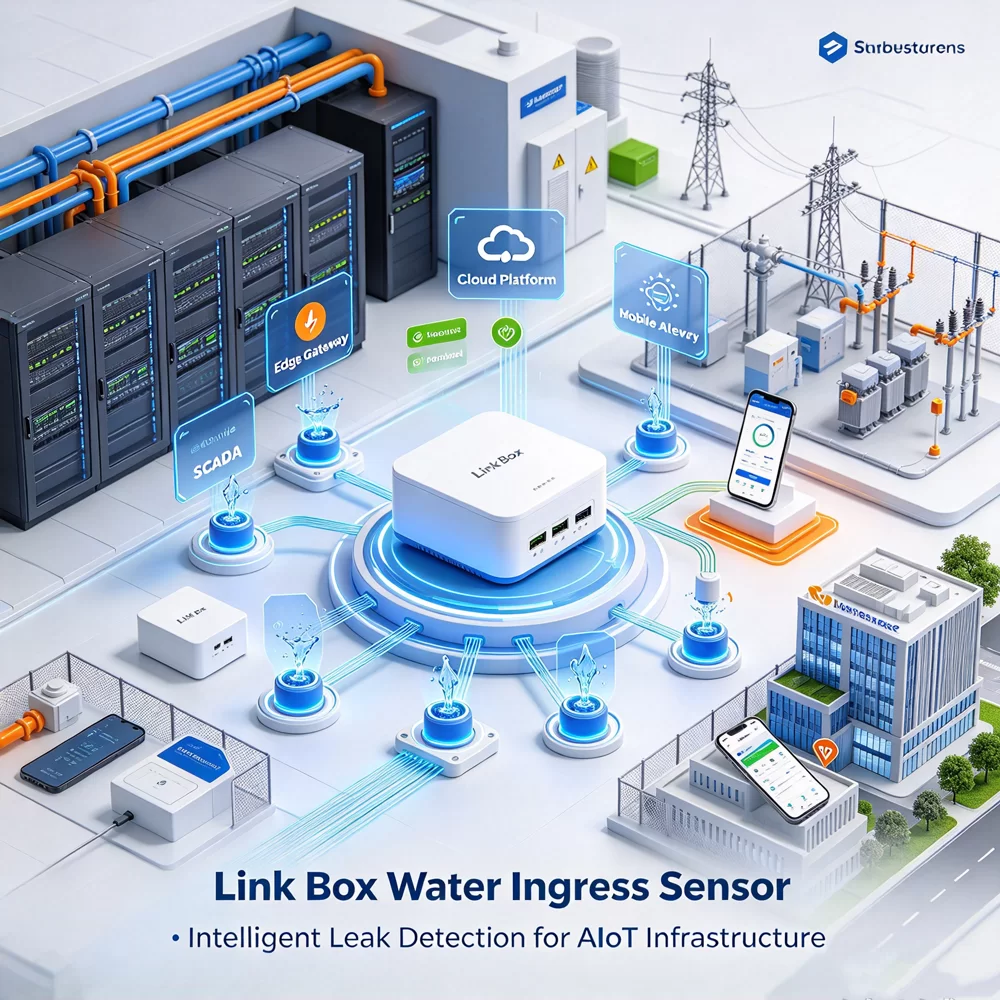
The Physics of Dual-Vector Deterioration: Moisture and Dielectric
Failure
Understanding the operational necessity of combined monitoring requires analyzing how external environmental moisture accelerates electrical degradation. Solid insulation materials used in medium-voltage busbars, distribution switchgear, and commercial transformer feeds undergo progressive deterioration when exposed to ambient moisture or standing water.
Moisture creates conductive paths along dusty or imperfect surfaces. When relative humidity reaches saturation or direct physical liquid immersion occurs, surface tracking currents begin to flow. These tracking currents carbonize organic insulating materials, creating permanent, low-resistance conductive channels. This process steadily increases residual current leakage. Without continuous edge monitoring, this degradation goes undetected until it results in phase-to-ground or phase-to-phase short circuits.
Simultaneously monitoring physical liquid accumulation and micro-ampere electrical deviations allows asset managers to intercept cascading failures before switchgear ruptures occur. Combining these sensors eliminates the physical space constraints typical of standard DIN-rail configurations inside crowded modular switchboards.
Architectural Deep Dive: Integrated Water Immersion and Electric Leakage Monitoring Terminal
The structural composition of a modern Integrated Water Immersion and Electric Leakage Monitoring Terminal integrates high-precision analog signal acquisition, galvanic signal isolation, edge signal processing, and robust industrial fieldbus communications.
1. High-Sensitivity Residual Current Acquisition
Electrical leakage monitoring relies on high-permeability magnetic cores deployed within specialized Current Transformers (CT). The zero-sequence current calculation operates on Kirchhoff’s Current Law: in a balanced polyphase electrical circuit, the vector sum of all line and neutral currents equals zero.
- Core Material Composition: High-permeability
nanocrystalline or permalloy alloys are selected to detect residual leakage
currents ranging from 10 mA to 1,000 mA across variable frequencies.
- Filtering Algorithms: High-speed internal analog-to-digital
converters (ADCs) operate in tandem with digital low-pass filtering to isolate
actual 50/60 Hz resistive leakage currents from capacitive high-frequency noise
generated by Variable Frequency Drives (VFDs) and switched-mode power
supplies.
- Galvanic Isolation: Optoelectronic or digital capacitive
isolation barriers prevent transient line surges from penetrating the internal
logic and processing components.
2. Multi-Mode Water Immersion Detection
Liquid detection methods depend on the operational environment. Field deployments utilize dual detection mechanisms based on project-specific requirements:
- Impedance-Based Resistive Sensing: Utilizing gold-plated or
stainless steel electrode probes positioned at designated drainage points or
false-floor bases. The presence of conductive liquid bridges the measurement
circuit, triggering a baseline impedance drop that registers instantaneously on
the microcontroller.
- Non-Conductive Liquid Photoelectric Sensing: Refraction-based optical prisms monitor deionized water or fluid variations
where conductivity is too low for standard galvanic probes.
- Anti-Corrosion Probe Design: Advanced systems engineered by
HAOSHENG incorporate AC excitation signals across sensing terminals rather than
continuous DC potentials. This architectural decision prevents electrolytic
corrosion and electrode passivation, extending sensor longevity across humid
industrial deployments.
3. Edge Computation and False Positive Suppression
Edge microcontrollers convert raw analog inputs into actionable engineering units. Rather than generating threshold trips on transient spikes, the device deploys temporal hysteresis and adaptive rate-of-change algorithms. Condensation drops or transient electrical spikes caused by switching operations are filtered via internal register timers, ensuring clean telemetry and actionable alarm states.
Communication Topologies and Telemetry Integration
Isolated monitoring units offer limited value without rapid upstream telemetry transmission. Industrial automation requires seamless connectivity across edge networks, Programmable Logic Controllers (PLCs), Supervisory Control and Data Acquisition (SCADA) platforms, and cloud platforms.
The internal communication stack of an Integrated Water Immersion and Electric Leakage Monitoring Terminal provides multi-layered transmission capabilities:
- Fieldbus Protocols: Standard RS-485 interfaces running
native Modbus-RTU provide direct, deterministic integration into centralized
plant control platforms and building management systems (BMS).
- Low-Power Wireless Telemetry: For sprawling cable
distribution tunnels and municipal piping where running physical communication
wiring is cost-prohibitive, transmission options like LoRaWAN, NB-IoT, and
Cat-M1 provide long-range telemetry.
- Local Visual and Acoustic Alarms: Localized LED indicators
denote operational status, insulation integrity, and liquid presence,
supplemented by high-decibel buzzers and dry-contact relay outputs to
immediately trip upstream circuit breakers or engage emergency sump
pumps.
Critical Application Environments
Deploying specialized sensing platforms protects valuable physical assets across diverse industrial environments.
Underground Utility Corridors and Cable Trenches
Municipal utility tunnels house vast networks of medium- and high-voltage transmission lines alongside drainage and civil plumbing infrastructure. These environments face groundwater seepage and heavy condensation. An integrated terminal monitors for localized pipe ruptures while continuously assessing the insulation resistance of aging cable jackets, preventing thermal events in subterranean spaces.
Hyperscale Data Centers and Edge Facilities
Modern server halls utilize dense liquid-cooling architectures alongside traditional CRAC/CRAH systems. Water distribution manifolds located directly above or adjacent to high-voltage server racks create an urgent need for multi-point liquid sensing. Combined monitoring units mounted at the base of Power Distribution Units (PDUs) trace micro-leaks from coolant loops while logging subtle current imbalances in power distribution feeds.
Industrial Switchgear and Motor Control Centers (MCC)
Manufacturing facilities with heavy chemical or mechanical processes operate amidst high ambient particulate levels, fluctuating humidity, and aggressive wash-down procedures. Installing a unified terminal provides localized enclosures with continuous ingress monitoring, safeguarding power distribution assets from unexpected degradation caused by cleaning run-off or roof deterioration.
Comparative Analysis: Modular Dual-Sensing vs. Disparate System Deployment
Selecting the right hardware architecture impacts both capital investment (CAPEX) and long-term operational expenditures (OPEX). Below is an engineering comparison between disparate sensor networks and integrated monitoring modules:
| Evaluation Parameter | Disparate Sensor Deployment | Integrated Dual-Parameter Terminal |
|---|---|---|
| DIN-Rail Footprint | Requires 4 to 8 modular widths across multiple enclosures. | Compact, single-chassis housing requiring 2 to 3 modular widths. |
| Wiring Complexity | Multiple independent power supplies, sensor lines, and separate bus lines. | Single consolidated auxiliary power input, unified communication output. |
| Electrode Oxidation Rate | High (primarily relies on low-cost DC excitation methods). | Negligible (uses advanced AC square-wave excitation algorithms). |
| System Diagnostics | Independent status flags; requires manual correlation within BMS. | Unified onboard logic; native correlation of moisture and leakage. |
| Installation Time | Extended commissioning and field address mapping per point. | Streamlined installation with single-point address mapping. |
Integrated hardware simplifies inventory control, speeds system commissioning, and reduces failure modes across complex, dynamic operations.
Edge Diagnostics and Predictive Asset Management
Transitioning from reactive alerting to predictive asset management represents the core advantage of intelligent AIoT components. Industrial facilities often experience catastrophic equipment failures because legacy components only trigger after standard threshold values are exceeded. This reactive operational model creates high recovery costs and prolonged operational downtime.
Modern architectures engineered by HAOSHENG emphasize predictive tracking. By reporting continuous parametric data rather than basic binary state shifts, the Integrated Water Immersion and Electric Leakage Monitoring Terminal allows central control engines to run trending analyses. When micro-ampere leakage increases in direct correlation with elevated local humidity readings, predictive maintenance teams can intervene to dry, clean, or repair terminal insulation weeks before an uncontained arc flash event develops.
Implementation Challenges and Engineering Solutions
Operating sensitive electrical measurement circuits alongside external liquid monitoring introduces specific engineering challenges:
Challenge 1: Ground Loops and Signal
Degradation
Installing water detection probes directly onto metal
cable trays or grounded concrete surfaces can create unintended ground loops.
These loops distort leakage current measurements on the CT line. High-tier
terminals mitigate this through fully floating sensor input stages and
differential analog conditioning, preventing external ground potentials from
affecting electrical measurement loops.
Challenge 2: High Environmental Particulates and
Condensation
Dust-heavy industrial sites often experience elevated
surface tracking across non-submerged probes. Terminals address this by
leveraging multi-threshold impedance profiling. The system differentiates
between thin, highly resistive moisture condensation films and low-resistance
bulk liquid immersion, ensuring operations run smoothly without unnecessary
false dispatches.
Challenge 3: High Ambient Electromagnetic Fields
Heavy
industrial environments produce severe electromagnetic radiation during the
switching of large inductive loads. Terminals utilize multilayer PCB grounding,
metal internal shielding, and advanced TVS diode arrays across all terminal
connection blocks to meet stringent IEC/EN electromagnetic compatibility (EMC)
operational standards.
Frequently Asked Questions (FAQ)
How does the terminal isolate capacitive leakage from dangerous resistive leakage?
The monitoring terminal's signal processing suite utilizes phase-angle analysis and fast Fourier transforms (FFT) on the residual current waveform. By comparing the phase alignment of the zero-sequence current with the reference bus voltage, the unit isolates the 90-degree phase-shifted capacitive charging currents from true in-phase resistive leakage, preventing false alarms in systems with long cable runs.
Can the water detection interface function effectively with non-conductive fluids?
Standard resistive liquid probes require conductive mineral ions to register continuity. If the monitoring application involves ultra-pure deionized water or dielectric transformer cooling oils, the terminal can be paired with auxiliary optical refraction or float-based micro-switches via configurable digital inputs.
What prevents electrochemical corrosion on the water immersion probes?
Electrochemical corrosion occurs when a continuous DC current passes through metallic probes immersed in an electrolyte. Quality terminals mitigate this by deploying low-frequency AC square-wave excitation across the sensing contacts. This continuous phase reversal prevents the migration of metal ions, protecting the probes over multi-year installations.
Does the terminal maintain local operation during an upstream communication disruption?
The device operates as a fully autonomous edge protection unit. Internal logic boards, threshold checks, non-volatile operational event memory, and output trip relays function independently of the main communication bus. Event history and alarms are logged locally and transmitted to the centralized SCADA platform as soon as communications restore.
What is the typical monitoring range for zero-sequence residual current?
The analog front-end accommodates input ranges from 20 mA up to 1,000 mA, supporting configurable alert and trip thresholds. Field parameters can be customized dynamically based on cable length, nominal system load, and downstream equipment ratings.
What physical maintenance is required for long-term operational integrity?
Routine maintenance includes periodic visual inspections and cleaning the water detection electrodes with an isopropyl alcohol wipe to remove accumulated non-conductive grease or dust layers. Current transformers require no physical maintenance beyond verifying terminal torque during regular facility maintenance windows.
Engineering Inquiries and Solutions Specification
Modern operational continuity demands proactive, edge-level visibility. Integrating environmental fluid detection with high-precision electrical leakage telemetry in a single, robust platform protects vital distribution infrastructure from costly downtime and structural failures. HAOSHENG develops mission-critical monitoring solutions designed to meet the rigorous demands of industrial automation and power distribution applications.
Connect with our technical application team to evaluate hardware specifications, request protocol documentation, or discuss custom requirements for the Integrated Water Immersion and Electric Leakage Monitoring Terminal.