




How a Link Box Water Ingress Sensor Works in AIoT Infrastructure Monitoring
Outdoor link boxes, fiber distribution hubs, pad-mounted cabinets and roadside utility enclosures operate in an environment that is permanently hostile to electronics. Rain, flooding, groundwater seepage, condensation cycles and seasonal temperature swings all push moisture toward seals, cable entries and gasket interfaces. When water reaches the interior, the consequences are rarely limited to a single component. Insulation resistance collapses, optical connectors cloud over, terminal blocks corrode, and the enclosure becomes a safety liability for field crews.
A Link Box Water Ingress Sensor is the instrument that turns this slow, invisible failure process into a measurable, actionable signal. Instead of discovering a flooded cabinet during a scheduled inspection months after the damage occurred, operators receive a threshold alarm within seconds of water contact or condensation build-up. That shift from reactive repair to condition-based maintenance is what makes moisture sensing a core element of modern AIoT infrastructure monitoring.
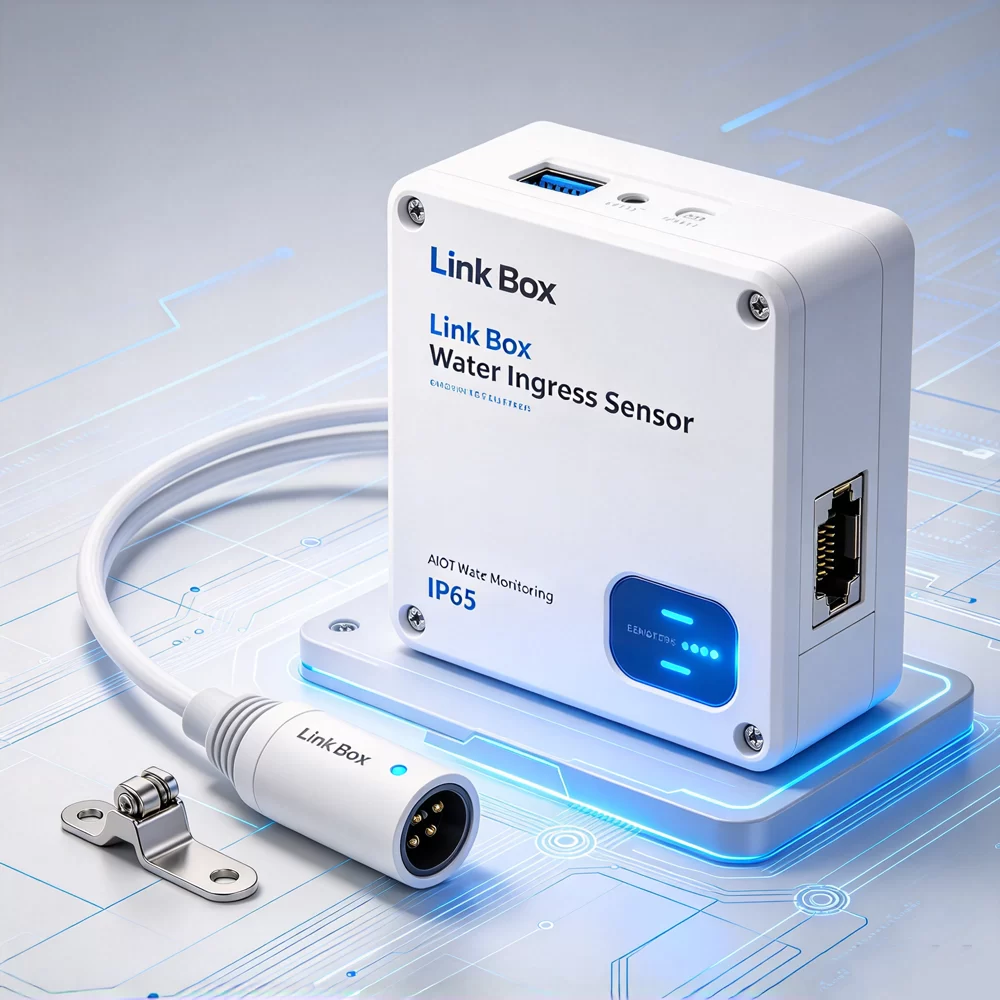
Why Moisture Inside a Link Box Is More Dangerous Than It Appears
Water ingress does not always arrive as a visible pool. In many field failures, the enclosure remains externally intact and the gasket shows no obvious breach. Moisture accumulates through capillary action along cable jackets, through imperfectly sealed gland plates, or through diurnal breathing as air inside the cabinet contracts at night and draws humid air past the seal. Once inside, that humidity condenses on the coldest surfaces, which are usually the metal chassis and the exposed contacts.
The failure chain develops in stages:
- Surface condensation raises relative humidity above the dew point threshold, forming a thin conductive film across insulators.
- Electrochemical corrosion begins at terminals, grounding bars and connector pins, raising contact resistance.
- Standing water bridges low-voltage circuits, triggering short circuits, false trips or intermittent faults that are difficult to reproduce.
- Optical and electronic modules degrade, reducing signal quality and shortening service life.
- Safety risk increases for technicians opening an enclosure that may contain energized conductors in contact with water.
Field maintenance data from telecom and distribution network operators consistently shows that a significant share of unplanned enclosure outages traces back to moisture rather than to component wear. The economic argument for continuous monitoring is therefore straightforward: the cost of one sensor node is a fraction of the cost of a single emergency truck roll, and far smaller than the cost of a regional outage caused by a failed distribution point.
How a Link Box Water Ingress Sensor Operates
Sensing Principles and Detection Elements
Different sensing technologies suit different enclosure conditions, and the correct choice depends on whether the target is standing water, condensation, or both.
- Conductive electrode sensing uses two or more exposed electrodes. When water bridges them, resistance drops sharply and the circuit asserts an alarm. The approach is inexpensive, robust and well suited to detecting standing water at the bottom of a cabinet.
- Capacitive sensing measures the change in dielectric constant near a sensing pad. Because it responds to thin films of moisture rather than requiring a conductive bridge, it detects condensation earlier than electrode designs.
- Optical or infrared sensing relies on total internal reflection at a prism surface. Water contact alters the reflection path, producing a highly repeatable digital output that is largely immune to electrode fouling and electrolysis.
- Float and ultrasonic sensing are used in sumps and cable pits where water depth measurement matters more than simple presence detection.
Signal Conditioning, Thresholds and False Alarm Suppression
Raw sensing output is rarely clean enough for direct alarm transmission. A well-designed Link Box Water Ingress Sensor applies several layers of processing before it reports an event. Debounce logic prevents a single droplet or momentary splash from generating an alarm. Temperature compensation adjusts thresholds as ambient conditions shift across the operating range. Baseline tracking accommodates slow drift caused by dust, oxidation or humidity history. Self-diagnostics verify electrode integrity and cable continuity, so a broken probe is reported as a sensor fault rather than silently disabling protection.
Alarm tiering is equally important. A two-stage threshold, one for early condensation warning and one for confirmed standing water, allows operators to differentiate between a maintenance task and an emergency dispatch. This distinction directly reduces unnecessary site visits, which is often the largest hidden cost in enclosure monitoring programs.
Technical Specifications That Determine Real-World Performance
Datasheet parameters should be evaluated against the physical conditions the enclosure actually faces, not against laboratory nominal values.
- Ingress protection: IP67 or IP68 for the sensor body and cable entry, with potted or hermetic sealing on the sensing head.
- Operating temperature: -40 °C to +85 °C covers most outdoor cabinets, with thermal shock testing confirming stability across rapid transitions.
- Response time: sub-second detection for standing water, typically under ten seconds for condensation films.
- Output interfaces: dry contact relay, RS-485 with Modbus RTU, 4-20 mA analog, or 0-10 V, depending on whether the host is a PLC, an RTU or an edge gateway.
- Power supply: wide-range DC input, with low-power variants supporting battery or PoE operation for sites without mains power.
- Surge and EMC immunity: compliance with IEC 61000-4-5 surge and IEC 61000-4-3 radiated immunity is essential for cabinets located near switching equipment or overhead lines.
- Corrosion resistance: stainless steel or coated alloy housings, with conformal coating on the PCB for salt-spray and chemical exposure.
- Mechanical durability: vibration and impact tolerance consistent with roadside and pole-mounted installations.
Mean time between failures and long-term drift figures deserve particular attention. A sensor that requires annual recalibration introduces a recurring labor cost that can exceed the hardware price within two service cycles.
Deployment Scenarios Across AIoT and Utility Infrastructure
Telecom and Fiber Distribution Networks
Street cabinets, cross-connect boxes and fiber access terminals are distributed across wide geographic areas, frequently in flood-prone or low-lying locations. Integrating a Link Box Water Ingress Sensor into the existing site monitoring controller allows the network operations center to correlate moisture alarms with temperature, door status and power events. The result is a prioritized work queue rather than a backlog of undifferentiated site alarms.
Smart Grid and Distribution Automation
Pad-mounted switchgear, ring main units and secondary distribution cabinets house equipment where moisture can cause partial discharge, insulation tracking and protective relay misoperation. Continuous moisture telemetry supports condition-based maintenance strategies and provides documented evidence for asset health reporting.
Industrial and Transportation Environments
Wash-down areas, tunnels, ports, rail side equipment rooms and cold storage facilities all present aggressive moisture conditions. Sensors with high chemical resistance and wide temperature tolerance are required, and integration with existing SCADA or building management systems is typically mandatory.
From Sensor to Cloud: Integration Architecture
A moisture sensor delivers value only when its signal reaches a system that can act on it. The typical architecture begins at the sensing element, which connects to an edge gateway over RS-485, a dry contact input or a low-power wireless link. The gateway aggregates moisture data with other environmental and electrical parameters, applies local rules for immediate action, and forwards summarized telemetry upstream over NB-IoT, LoRaWAN, 4G or Ethernet.
Northbound connectivity options include MQTT for cloud IoT platforms, SNMP traps for network management systems, Modbus TCP for industrial historians, and REST APIs for custom dashboards. Alert routing should support escalation logic, such as notifying a regional maintenance team after a condensation warning persists for a defined interval. HAOSHENG designs its enclosure monitoring hardware around this layered model, so that a single sensor can serve a legacy SCADA environment today and migrate to a cloud-native AIoT platform without hardware replacement.
Installation and Commissioning Best Practices
- Mount the sensing head at the lowest practical point of the enclosure, while avoiding locations where water pools only after severe flooding and never during normal condensation events.
- Keep the probe clear of cable bundles, which can trap moisture and create false wet conditions.
- Route sensor cabling through dedicated gland entries with proper sealing and strain relief; an unsealed auxiliary port defeats the purpose of the sensor.
- Verify grounding and surge protection on the signal path, particularly for cabinets with overhead shielding wires.
- Record the commissioning baseline reading and the configured alarm thresholds in the asset register for future comparison.
- Test each unit with a controlled water application before closing the enclosure, confirming end-to-end alarm delivery to the monitoring platform.
Common Failure Modes and Mitigation Strategies
Electrode-based units are vulnerable to contamination from dust, insect debris and mineral deposits, which can create a permanent conductive path that mimics water presence. Periodic self-test routines and replaceable sensing heads address this. Electrolysis corrosion occurs when DC excitation is applied continuously to exposed electrodes in a damp environment; AC excitation or pulsed sampling significantly extends probe life. Lightning-induced surges on long signal runs remain a leading cause of premature electronics failure, making external surge protection a practical requirement rather than an option.
Condensation-only events are another source of nuisance alarms. Selecting a sensor with adjustable thresholds and a confirmed-event delay helps distinguish between a harmless dew film and genuine water accumulation. For applications where both conditions matter, a dual-element sensor combining capacitive and conductive detection provides better discrimination than either technology alone.
Selection Criteria for Procurement and Engineering Teams
Technical evaluation should weigh the following factors against the specific deployment profile:
- Detection target: standing water, condensation, or both.
- Environmental rating matched to the enclosure's actual exposure class.
- Output protocol compatibility with the existing controller or gateway.
- Power availability and consumption budget at the site.
- Calibration interval and field serviceability.
- Certification for the target market, including EMC, safety and where applicable hazardous area approvals.
- Availability of documented integration libraries and technical support from the manufacturer.
HAOSHENG supplies water ingress sensing modules together with the gateway, power and communication hardware needed to complete an enclosure monitoring node, which shortens integration cycles and reduces the risk of interface mismatches between vendors.
Frequently Asked Questions
Q1: What is the difference between a water ingress sensor and a humidity sensor?
A humidity sensor reports the moisture content of the air inside the enclosure and is useful for predicting condensation risk. A water ingress sensor detects the actual presence of liquid water or a conductive moisture film on a surface. The two are complementary: humidity data supports preventive action, while ingress detection confirms that a physical event has occurred.
Q2: Can a Link Box Water Ingress Sensor operate without mains power?
Yes. Low-power variants are designed for battery or solar-assisted operation, using pulsed sampling and event-driven transmission to extend battery life to several years. These are commonly paired with NB-IoT or LoRaWAN gateways in locations where no low-voltage supply is available.
Q3: How often does the sensor require calibration?
Optical and capacitive designs with self-diagnostics typically need no routine field calibration. Conductive electrode sensors may require inspection or cleaning every twelve to twenty-four months depending on contamination levels. Selecting a unit with automatic baseline tracking reduces this burden considerably.
Q4: Will condensation trigger a false alarm?
Condensation is a genuine moisture event and is often the earliest indicator of a failing seal. The practical question is whether it should be treated as a warning or an emergency. Configurable thresholds and confirmation delays let operators route condensation events to scheduled maintenance and reserve immediate dispatch for confirmed standing water.
Q5: How does the sensor integrate with an existing SCADA or NMS platform?
Most industrial deployments use RS-485 with Modbus RTU, dry contact outputs or 4-20 mA signals, all of which connect directly to RTUs and PLCs. For cloud platforms, an edge gateway converts the local protocol to MQTT or HTTPS. SNMP traps remain the standard route into network management systems in telecom environments.
Q6: What IP rating should be specified for a roadside cabinet?
IP68 is recommended for the sensing head and cable terminations in applications subject to flooding or temporary submersion. IP67 is generally adequate for elevated cabinets protected from standing water but still exposed to driving rain and wash-down.
Q7: Can one monitoring node support multiple sensors?
Yes. A single gateway can typically host several moisture sensors across adjacent compartments or cabinets, along with temperature, door contact and power monitoring inputs. Consolidating these signals into one node reduces installation cost and simplifies data management.
Request a Technical Proposal for Your Enclosure Monitoring Project
Engineering teams specifying moisture protection for telecom, distribution or industrial enclosures can request a detailed technical proposal from HAOSHENG, including sensor selection guidance, integration diagrams, protocol documentation and sample evaluation units. Share your enclosure type, environmental exposure class, existing communication infrastructure and alarm management requirements, and our application engineers will respond with a configuration matched to your deployment conditions.