




Cable Leakage Current Monitoring: Sensors, Methods and Alarm Thresholds
"Leakage current" means different things depending on who you ask. On a 400 V feeder it usually means residual current flowing to earth through damaged insulation. On a 110 kV single-core cable, "cable earth current" usually refers to the current in the sheath grounding leads, which can reach tens of amperes even when the cable is healthy. Use the wrong sensor for the job and you end up with data that looks precise and tells you nothing.
This guide separates the three currents that fall under leakage current monitoring, shows how each one is measured, and covers sensor selection, installation and alarm thresholds.
Three Currents People Call "Leakage Current"
| Current | Where it matters | Typical magnitude | Measured with | What it tells you |
|---|---|---|---|---|
| Insulation leakage current | MV and HV cables | µA to mA | Online insulation monitoring | Insulation ageing, moisture, water treeing |
| Residual (earth leakage) current | LV feeders and distribution circuits | mA to hundreds of mA | Residual current transducer (core-balance CT) | Earth faults, insulation damage, fire risk |
| Sheath grounding / circulating current | HV single-core cables with bonded sheaths | A to tens of A or more | CT on each grounding lead in the link box | Sheath damage, bonding faults, water in link boxes |
Insulation leakage current
Every cable insulation passes a small current to earth. In AC systems most of it is capacitive charging current, which is normal. The resistive part is what matters: it grows as insulation absorbs moisture, develops water trees or suffers mechanical damage. Because this current is tiny compared with load current, it is usually tracked indirectly by measuring insulation resistance.
Residual current
In a healthy low-voltage circuit, the currents in the phase and neutral conductors add up to zero. Any difference, the residual current, has to be returning through an earth path. Residual current monitoring for cable feeders catches insulation faults long before they turn into short circuits or fires.
Sheath grounding current
In high-voltage single-core cables, load current induces a voltage in the metallic sheath. Where the sheath is bonded to earth, this drives a circulating current through the grounding leads. Strictly speaking this is not a leakage current, but it is the value utilities monitor in link boxes. A sudden change points to sheath insulation damage, a failed cross-bonding connection or water in the box.
Methods of Leakage Current Monitoring
1. Residual current transducer on LV feeders
A core-balance current transformer encloses all live conductors of a circuit, meaning every phase plus neutral but not the protective earth. The transducer outputs the residual current as mA, 4–20 mA or an RS-485 digital value. This method is precise and specific to one circuit, so it is the standard approach for a cable leakage current transducer.
- Type AC responds to sinusoidal AC residual current only.
- Type A also detects pulsating DC.
- Type B also detects smooth DC, which you need on circuits with variable-speed drives, PV inverters or EV chargers.
A residual current monitor (RCM, covered by IEC 62020) alarms without tripping. That suits data centers, hospitals and process lines, where unplanned tripping costs more than the fault itself.
2. Earth leakage current sensor on the grounding conductor
A split-core or clamp-on CT around a protective earth or grounding conductor measures the total current flowing to earth from everything downstream. An earth leakage current sensor installed this way is easy to retrofit and works well as a ground leakage current monitor for a whole panel or a transformer neutral earth. However, it cannot tell you which circuit is leaking, and stray currents from other parts of the earthing system can distort the reading.
3. Sheath grounding current in HV link boxes
For high-voltage cables, one CT goes on each phase's grounding lead inside the direct-grounding or cross-bonding link box. Look at three values together, not just the absolute current:
- the absolute sheath current;
- the ratio of sheath current to load current;
- the ratio between the highest and lowest phase.
Several utility O&M codes use rules of thumb such as sheath current below 100 A, below 20% of load current, and a max/min phase ratio below 3. Always follow the thresholds in your own utility's specification.
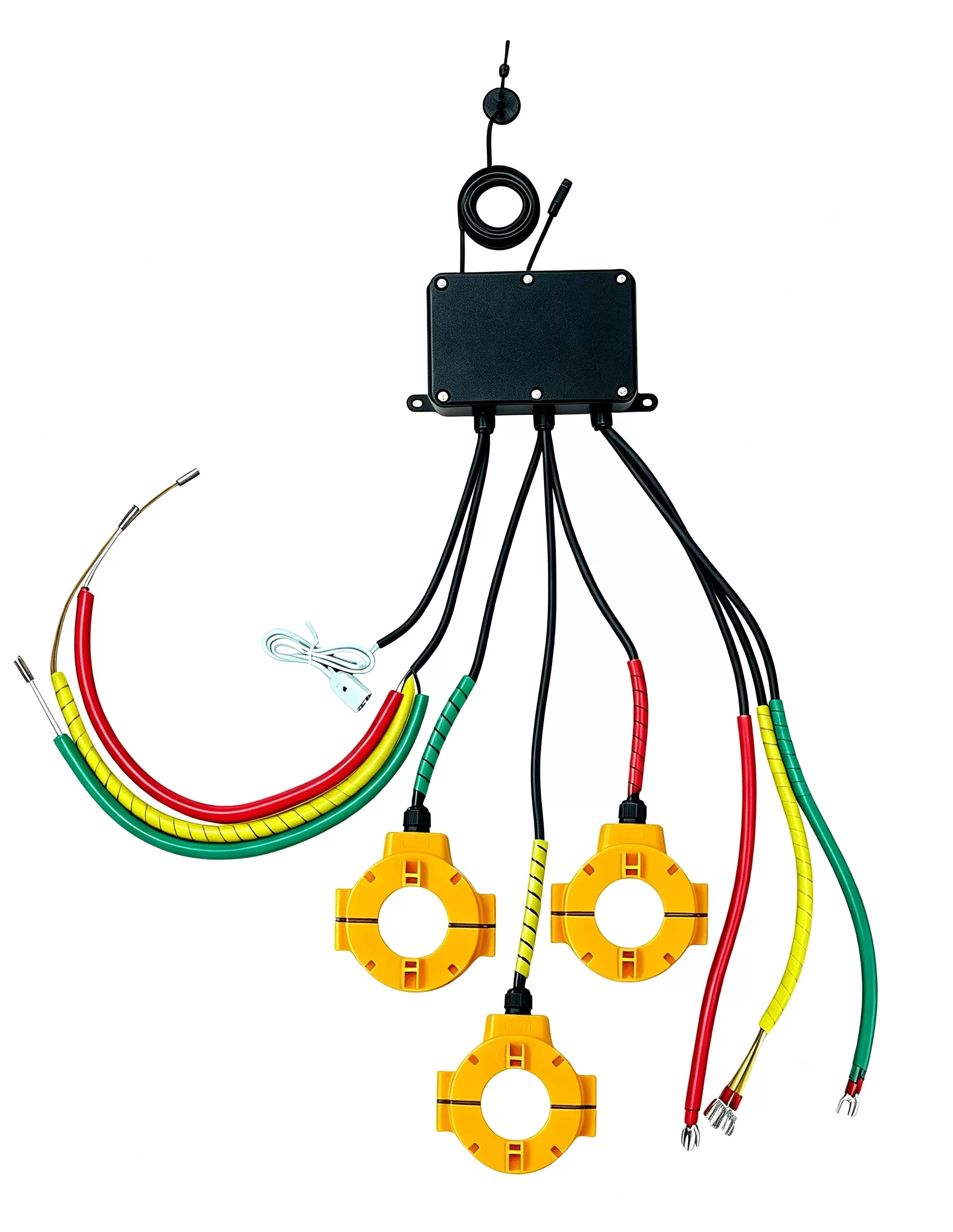
The HAOSHENG cable link box monitoring device measures 3-channel sheath circulating current (0–100 A, ±0.05 A), 3-channel induced voltage (0–100 V, ±0.5 V), 3-channel temperature (−50 to +200 ℃, ±1 ℃) and water immersion. It has an IP68 sealed housing and RS-485/WiFi communication with Modbus and MQTT.
4. Online insulation resistance monitoring
Instead of waiting for leakage current to appear, you can track the insulation itself. Online monitoring of sheath insulation resistance under live conditions shows a falling trend as moisture enters or the outer sheath is damaged. That gives you an early warning, well before a leakage fault develops.
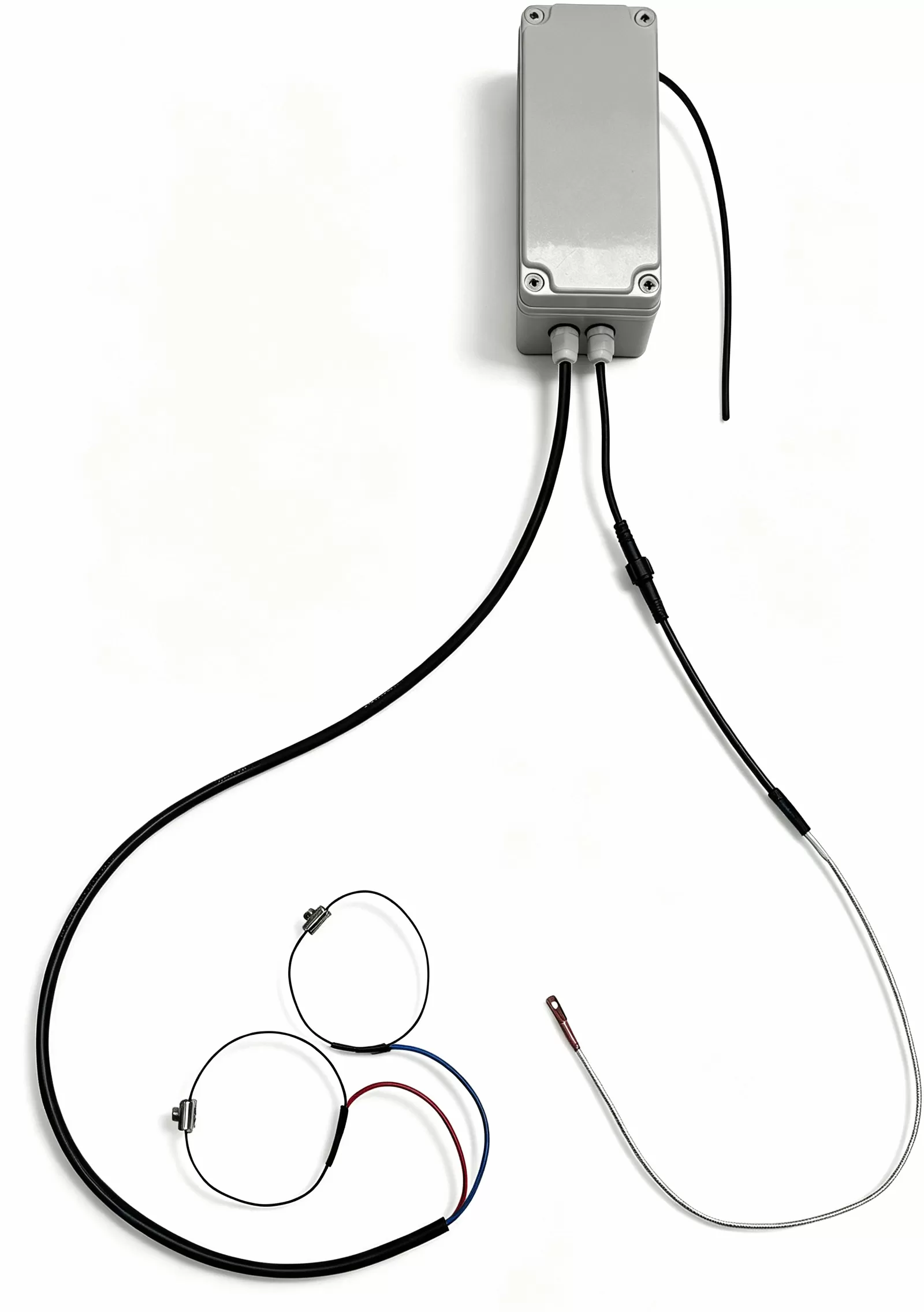
The HAOSHENG cable insulation monitoring device measures insulation resistance from 10 kΩ to 5 MΩ (1 kΩ resolution) together with cable surface temperature. It straps onto the outer sheath, is rated IP67 and supports RS-485/WiFi (4G optional) with Modbus-RTU and MQTT, plus Bluetooth for on-site commissioning. Note that this device measures insulation resistance, not residual current; the two methods complement each other.
How to Choose a Cable Leakage Current Transducer
- Measuring range and resolution: mA resolution for residual current, amperes for sheath current. A sensor built for 100 A cannot resolve a 30 mA fault.
- AC/DC sensitivity: pick Type A or Type B when the load includes electronics that produce DC components.
- Aperture size: the CT window must fit all conductors, or the full cable, with room to spare.
- Low-current accuracy and temperature drift: accuracy near the alarm threshold matters more than accuracy at full scale.
- Output: 4–20 mA suits PLCs, while RS-485 Modbus RTU or wireless output makes networked monitoring simpler.
- Protection rating: use IP67/IP68 for manholes, tunnels and link boxes that may flood.
- Power supply: DC supply, battery or CT energy harvesting, depending on the site.
- Installation: split-core CTs avoid disconnecting cables during retrofits.
- EMC immunity: sensors near HV cables and switchgear need certified EMC performance.
Installation Tips That Prevent False Readings
- For residual current, pass all live conductors, including neutral, through the CT. Never pass the protective earth conductor through it.
- If the cable screen or armour is earthed on the far side of the CT, route the screen earth lead back through the CT. Otherwise sheath currents cancel out or add to the reading.
- Center the conductors in the CT window and keep it away from high-current busbars.
- In link boxes, fit one CT per phase grounding lead and label the phases clearly. Swapped phases make ratio alarms meaningless.
- Seal cable entries and add water immersion detection. Water ingress is one of the most common causes of abnormal sheath current.
- Record a baseline after commissioning. A healthy system still has some standing leakage, and changes from the baseline tell you more than absolute values.
Setting Alarm Thresholds
- Tiered alarms: set a warning level for investigation and an alarm level for action.
- Trend alarms: a steady rise over days is often the first sign of insulation degradation, even while values are still below the absolute limit.
- Load-correlated limits: sheath current rises with load, so compare it with load current rather than using one fixed number.
- Time delays: a short delay filters switching transients and inrush without hiding real faults.
- LV design margin: a common design rule, found for example in BS 7671, keeps standing protective conductor current below 30% of the RCD rated residual current to avoid nuisance tripping.
Bringing Leakage Data into SCADA and the Cloud
Most leakage and sheath current sensors output Modbus RTU over RS-485. A gateway polls them and passes the data on as Modbus TCP for SCADA or as MQTT for a cloud platform. Our Modbus RTU to TCP converter guide covers wiring and configuration in detail.
- The IoT Data Acquisition Gateway handles multi-channel RS-485 acquisition with Modbus TCP and MQTT output.
- The cable monitoring edge gateway adds local computing and optional 4G/5G/LoRa for tunnels and remote cable routes.
- The smart link box retrofit solution combines sheath voltage, circulating current, temperature and water monitoring into one platform.
- For cable joints in manholes, the explosion-proof cable junction box sensor and the CT passive temperature monitoring kit add joint temperature, which often rises before a leakage fault appears.
FAQ
What is the difference between earth leakage current and residual current?
Residual current is the imbalance between the live conductors of one circuit, measured with a core-balance CT around those conductors. Earth leakage current is usually measured on an earth conductor and includes everything flowing through it. Residual current pinpoints a circuit; earth leakage gives an overall picture.
Can I use a clamp meter as a ground leakage current monitor?
A leakage clamp meter is good for spot checks and fault finding. Continuous monitoring needs a fixed sensor with alarm logic and a communication link, because intermittent faults rarely show up during a site visit.
Is sheath circulating current the same as leakage current?
No. Sheath circulating current is induced by load current in bonded HV cable sheaths and can be large on a healthy cable. It is still monitored because abnormal values point to sheath or bonding faults. True insulation leakage current is far smaller and is best tracked through insulation resistance.
Which sensor should I use for high-voltage cables?
Combine sheath grounding current monitoring in the link boxes with online insulation resistance monitoring and joint temperature measurement. Together they cover bonding faults, insulation ageing and overheating joints.
Does HAOSHENG supply residual current transducers for LV feeders?
Our standard range covers HV sheath current, cable insulation resistance and temperature monitoring. For low-voltage residual current projects, contact our team to discuss ODM development based on your range, output and installation requirements.